If you are assessing AI for your commerce stack, you have probably noticed that almost every vendor now calls its product “agentic.”
The label is being applied to everything from basic recommendation engines to simple checkout automations. Yet a retailer that buys a system described as agentic but unable to execute is building on a foundation that can fail when it matters most.
The word needs a commercial test. A system is executing commerce when it can understand what your customer means, act within your rules, and complete the next step of the journey with intent, authorisation and context still intact. A system that can only describe what the customer could do next may be useful. It is not yet executing commerce.
This article defines that test, explains why the market has blurred the term, and shows how to assess a vendor’s claim before you buy.
What Does Agentic Commerce Actually Mean?
An agentic system can plan, reason and act toward a goal across several steps, adjusting as conditions change. Think of the difference between an assistant that gives you directions and one that drives you to the destination, rerouting when the road is blocked.
In commerce, the test has three parts: intent, control, and execution.
| Test | What it means in commerce | What failure looks like |
| Intent | The system can work out what the shopper actually wants and retain that understanding as the journey moves. | It parses a query, makes a plausible recommendation, then loses the shopper’s need at the next handoff. |
| Control | The system works within live pricing, inventory, policy and authorisation rules, with a defensible record of what it did. | It takes an action that cannot be traced, explained or defended when something goes wrong. |
| Execution | The system completes the next appropriate step without losing the customer’s context, whether that step happens in a conversation, checkout or another approved channel. | It hands the shopper to a disconnected flow, leaving them to repeat their need or rebuild the transaction. |
Intent Is More Than Parsing a Query
A commerce system does not understand intent simply because it can identify a product category. It needs to work out what the customer means: the occasion, budget, fit, urgency, constraints and trade-offs that make one answer useful and another wrong.
It also needs to hold onto that understanding as the journey develops. Context does not fade gradually. It dies at handoffs, when a conversation passes to a checkout that knows nothing about it. That is where many “agentic” journeys fall apart.
Conversational commerce is already well established. It uses natural language, voice, and image to help people discover products and get answers while the shopper controls each decision. It is genuinely useful, and for many shopping journeys, it is exactly what the customer wants. Agentic commerce adds the ability to carry that informed intent into a governed next action.
Control Is a Commercial Requirement, Not an Abstract Virtue
Control means more than adding a guardrail to a prompt. The actions an agent takes need to be tied to the customer’s approval and the merchant rules that govern the transaction: the relevant catalog, price, availability, promotion, policy, order and return conditions.
When something goes wrong, a merchant should be able to answer four questions: what did the customer approve, what did the system select, what rules did it apply, and what was charged? A transaction the merchant can stand behind is, in practice, a question of liability. Without a verifiable record, the merchant carries the risk when the system errs.
The principle is straightforward. The hard part is connecting that control to real systems, so the agent’s action is one the business can defend.
Execution Is Not the Same as a Chat-Based Checkout
Execution does not mean forcing every purchase into a chat window. Conversation may be the right place to guide discovery, resolve uncertainty or prepare an order. Checkout may belong elsewhere. What matters is that the next step happens where it should, with nothing important lost along the way.
In a commerce setting, the system tracks what a shopper is trying to do, assembles the basket, applies the right pricing and policy rules, and carries the order or next approved action forward. The shopper states an intention, and the system works to complete it without making them start again.
The market has stopped drawing this line clearly.
Why “Agentic” Became a Marketing Word
Gartner calls the wider AI trend “agent washing”: rebranding existing products, such as chatbots and AI assistants, as agentic without adding genuine autonomous capability. The firm estimates that only around 130 of the thousands of vendors claiming to offer agentic AI are doing something that fits the definition.
The budget impact is already visible. Gartner expects more than 40% of agentic AI projects to be cancelled by the end of 2027, citing escalating costs, unclear business value and weak risk controls. Many of these projects were sold on a promise the underlying technology could not keep.
The gap is visible in products buyers already know. Walmart’s Sparky and Amazon’s Rufus can compare items, summarise reviews and answer questions, and both are often described as agentic. In practice, they stop short of planning a multi-step task or acting across systems on the shopper’s behalf. They are conversational layers over a catalog, which is a perfectly good thing to be. The confusion begins when that capability is sold as something further along.
What Real Agentic Behaviour Looks Like
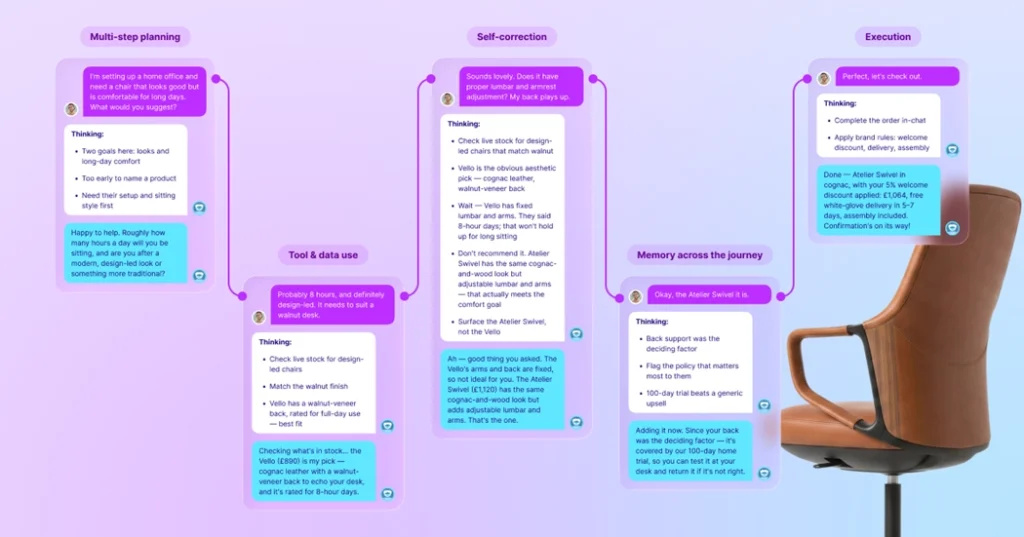
The label may be unreliable, but the behaviour is not. A genuinely agentic system has a set of characteristics you can test, whatever the marketing says.
| Behaviour | What it means in practice |
| Persistent intent and goal state | Works out the shopper’s need, breaks a goal into stages and carries that intent forward rather than answering one question at a time. |
| Multi-system orchestration | Uses live product, pricing, inventory, order and policy data to make a decision, not just to describe options. |
| Adaptive reasoning | Recognises an error, dead end or missing information, then adjusts or escalates rather than producing a confident wrong answer. |
| Memory across the journey | Keeps context as the shopper moves from discovery to comparison to purchase, rather than losing it at a handoff. |
| Governed, verifiable execution | Completes the next approved action using the brand’s rules and live data, with a record that can be reviewed if the transaction is challenged. |
This final point is where many tools labelled “agentic” stop. A system can hold a fluent, helpful conversation and still hand the shopper back to a standard checkout flow at the end. Discovery improves, but the sale is left to the same process as before. Or an action is taken without the context, rule enforcement or traceability the merchant needs to stand behind it.
Where Agentic Commerce Really Stands Today
Any honest assessment of agentic commerce has to start with its limits. True end-to-end autonomy, where an agent independently sources, negotiates and buys across systems with no human in the loop, is not generally available for most shopping scenarios yet. Commerce systems were built around structured catalogs and tightly controlled, compliance-bound workflows. That gives an open-ended agent little room to act freely.
Agentic capability is real today in specific, governed flows. Cart management and checkout can be completed from a connected discovery journey, with the system constructing the basket and carrying the order forward while staying within the brand’s pricing and policy rules. This is where the commercial value is easiest to defend, because it reaches the point where revenue is made and where the cost of an incorrect action can be measured.
Bain & Company estimates the agentic commerce industry will be worth $300 to $500 billion by 2030. That is why getting the architecture right is a strategic imperative, not a technical preference.
How to Evaluate a Vendor’s “Agentic” Claim
The label on the box tells you very little. Test the behaviour instead. Start with three questions, including when you assess Rezolve Ai.
1. Does it understand intent well enough to disambiguate, not just recommend?
2. Does it enforce my rules provably, with a record I could take into a dispute?
3. Can it write a real order into my systems, not just a suggestion into a chat?
Then use the following questions to judge the answer.
| Ask the vendor | What a strong answer looks like |
| Does it complete a purchase or only describe one? | It carries the order or next approved action into the right downstream system, not just to a cart or a handoff. |
| Does it hold context across multiple steps? | It tracks, updates and preserves intent as the shopper moves through the journey. |
| What happens when it hits an error or a gap in the data? | It self-corrects or escalates rather than producing a confident wrong answer. The escalation preserves the original context. |
| Is execution governed by your pricing, policy and inventory? | Every action uses the brand’s live data and rules, with an auditable explanation of what was selected and why. |
| Is it running in production or in a pilot? | It has named deployments and measurable results, not just a demo environment. |
If a vendor’s “agentic” product cannot complete a governed transaction while holding context, it is conversational commerce under a more ambitious name. Conversational commerce has real value. The risk is paying for execution you are not getting.
You do not need another isolated interface or a pilot sitting beside search, merchandising and checkout. You need a connected capability that can guide discovery, support a decision and complete the next action safely.

Why the Definition Is a Commercial Decision
Agentic commerce is a real shift, and it will change how shoppers buy and how brands compete. The reason to define it carefully is commercial. A buying decision made against a slippery definition can leave you with a tool that handles the conversation well but never moves the customer to a completed, defensible transaction. The bill for that arrives long after the contract is signed.
The label matters less than the outcome. Can your customer get from intent to a transaction you can stand behind?
Rezolve Ai is designed around that connected commercial loop. brain commerce supports discovery and guided decision-making using commerce-specific product, offer and customer context. brain checkout is designed to carry agent-assisted and agent-initiated transactions into execution, using live commerce-system connections. Underneath both, brainpowa is built to reason over structured commerce entities such as SKUs, variants, pricing, inventory and policy rather than generic text alone.
The aim is not to make every customer journey look more autonomous. It is to make the right journeys more complete, controlled and accountable. Start with a flow where the merchant can define the rules, preserve the context and measure the outcome. Expand only when the business can stand behind the next action.
Book a Rezolve Ai demo to map governed, intent-driven execution across your catalog.