
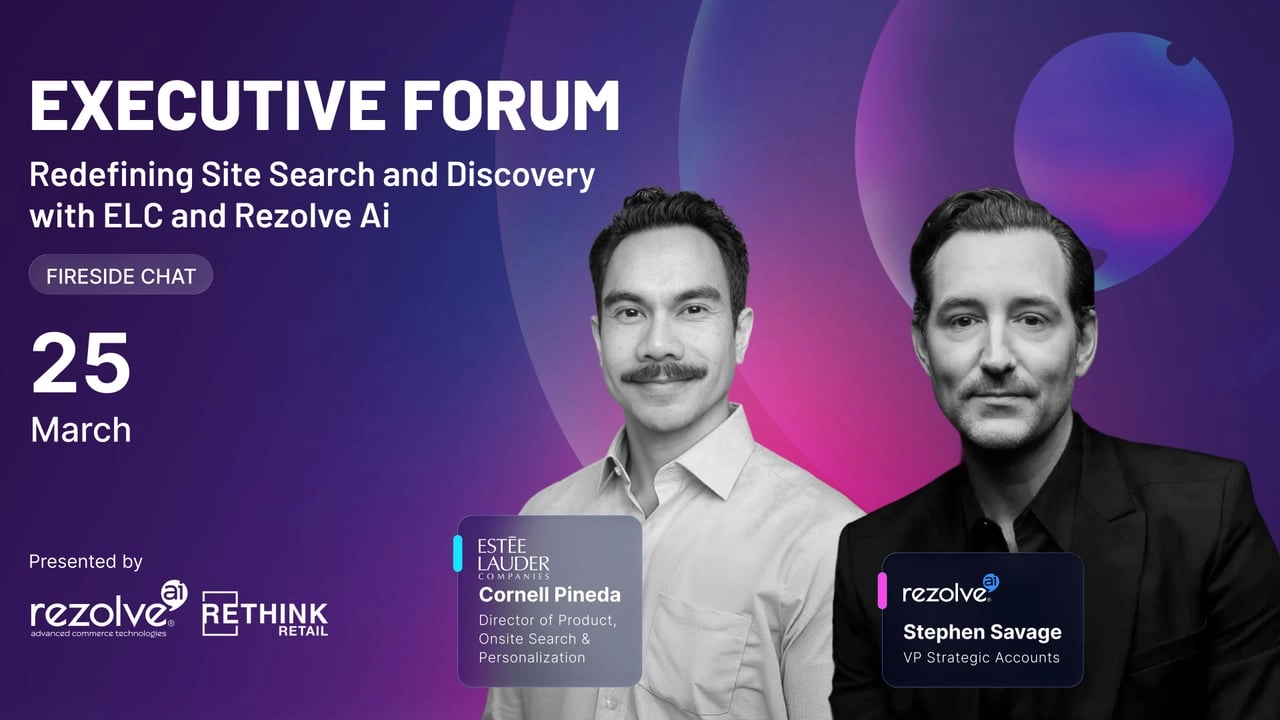
How are technology decisions shaping the future of prestige beauty? At Shoptalk Las Vegas 2026, The Estée Lauder Companies shared why accuracy, brand authenticity and real-time agility are now core to commerce, and how the company is building for it.
Prestige beauty has always run on trust. Today, AI-powered commerce has to earn that same trust by understanding brands, products and shopper intent with precision. At Shoptalk Las Vegas, The Estée Lauder Companies shared how it is approaching that challenge, working with Rezolve Ai.
Cornell Pineda, Director of Product, Onsite Search and Personalization at The Estée Lauder Companies, joined a session with Stephen Savage on what it takes to redefine site search and discovery at scale.
The customer has already done their homework
Pineda opened with an insight from a recent study of beauty shoppers across the US and Canada. He described a shopper who browses four to five fragrance subreddits every week and never blindbuys anymore. Opinions increasingly form off-site, in grassroots communities and feeds, long before a customer lands on a brand page.
That changes the role of a brand’s website. Pineda describes The Estée Lauder Companies’ brand sites as its flagship stores, open 24/7 and serving as the final source of truth for each brand’s story. By the time a shopper arrives, the site has one job above all others, which is to clarify what they may have already heard, in the brand’s own voice.
Accuracy is the foundation, and it is harder than it looks
Accuracy, Pineda noted, is the number one pain point in search, and in beauty the stakes are higher still, because trust, once lost, is “very hard to get back.” It also means different things to different shoppers. Some want an exact product-name match, while others expect the system to read past a typo and understand the intent. A good search engine, like a good shop assistant, has to meet both expectations in the moment.
This problem is harder than it first appears. General-purpose AI can generate a convincing answer, but commerce demands systems that verify those answers against live product, inventory and transaction data. A model trained on the open web is built to sound plausible. It is not built to be right about a specific catalog. Peer-reviewed research has found that, left unchecked, leading foundation models make unsupported claims about a customer’s journey in up to one in twelve interactions. In commerce, a confident answer that is wrong is a returned order, a call to customer service, and a customer who trusts you a little less.
That is precisely the challenge specialist commerce AI is designed to solve. Rezolve Ai’s approach pairs a commerce-tuned model, brainpowa, with a verification layer, TraceWare, that checks an AI’s output against what actually happened in the catalog and the transaction record, so an agent acts on verified facts rather than plausible ones. In peer-reviewed testing accepted at ACM UMAP 2026, that verification layer reached 99.5 to 100 percent accuracy in tracking a shopper’s journey, across leading foundation models and without retraining them.
An algorithm should elevate a brand, not flatten it
For Pineda, accuracy is necessary but not sufficient. The experience also has to feel like the brand. On a La Mer site, discovery should feel like luxury skincare. On MAC, it should feel like a makeup artist’s studio. “The algorithm doesn’t change that,” he said. “It actually elevates our brands.”
Built to scale across a portfolio
The Estée Lauder Companies runs more than 250 websites worldwide. Building capability brand by brand, market by market, Pineda explained, slows everyone down. A core platform lets the company “build a capability once, deploy it through an entire ecosystem, and learn from it” in real time, with every search query analyzed by region and market.
On personalization, Pineda drew a clear line. It “can’t be deterministic. It should be directional.” Shoppers will share data, but they do not want to be boxed into a wall of bestsellers that reads like a sponsored feed. The system should recognize what someone has viewed or bought before and still surprise them with something new, because discovery is the whole point of buying beauty.
Where this goes next
Discovery is moving fast. Shoppers still type keywords into a search bar, but they are also searching by image and expressing intent more naturally, trusting the technology to surface the right products. As our recent report, Search is Becoming a Conversation, and Retailers Aren’t Ready, sets out, the question is no longer whether shoppers will shop this way, but which retailers’ infrastructure is ready to meet them there.
As AI reshapes digital commerce, the winners won’t simply be the retailers that adopt AI first. They’ll be the ones deploying AI that understands their brands, earns customer trust and delivers accurate experiences at scale. That is the future The Estée Lauder Companies is building, and one Rezolve Ai is proud to help enable.