Here’s a little experiment to try before your next leadership meeting. Open ChatGPT, Claude, Perplexity or Gemini and type in a question your customers might ask. Something like “What’s the best high-yield savings account right now?” or “Which payment platform should a small online store use?”
You’ll get a confident, friendly answer, usually with a handful of company names in it. Now the real question: is your company one of them?
That’s what we set out to answer, at scale, for Money20/20 USA in Las Vegas. More and more people now ask an AI assistant where to bank, how to pay and who to trust with their savings. For a growing number of customers, that answer is becoming the new front door to financial services. We wanted to know who makes it through that door, and who doesn’t.
The short version
- About half of the finance companies we studied (1,077 of 2,219) were not visible in the AI answers in our study.
- Size matters more than sector. One in five S&P 500 financials is never named. Among Money20/20 attendees, it’s one in two.
- AI names the most companies when people are just looking around, and far fewer once they’re ready to buy.
- AI builds its answers mostly from third party websites, and in finance that means comparison sites above all.
- Only 5 of 2,034 attendee websites publish a way for an AI agent to check out.
How we did it, in plain English
We built a list of 2,219 finance companies. Most of them (2,053) were companies attending Money20/20 USA. The rest came from the finance companies in our wider US AI Visibility Study , plus a short list of well-known brand names in each category.
For every company, we wrote 15 questions about its market, phrased the way a real customer or buyer would naturally ask. Every prompt was ‘unbranded’, so no question ever mentioned a brand or company name. So, whenever an AI assistant brought a company up, that was entirely the assistant’s own choice.
Here’s what that looks like in real life.
| The question: “What are the best credit unions for active duty military and their families?” How Perplexity’s answer began: “The best choices are Navy Federal Credit Union, PenFed Credit Union, and Service Credit Union. Each offers military-focused eligibility or benefits…” What we counted: a mention for Navy Federal, and a good one, because it comes first. |
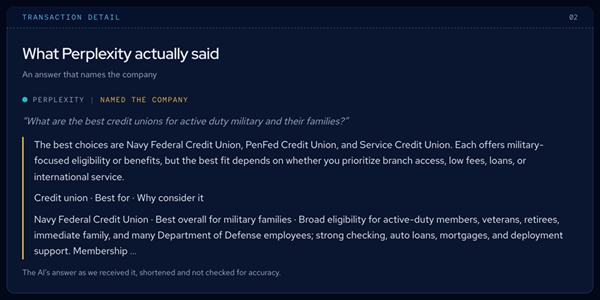
Here’s that answer on Navy Federal Credit Union’s page in the study, as Perplexity gave it.
The questions change with each company’s market. For SWIFT, they were about cross-border payments, such as “Why do some international wire transfers take several days to complete?” For PTO Exchange, a much smaller company that turns unused paid time off into benefits, they were questions like “Is offering a paid time off exchange program worth it for mid-sized employers in the U.S.?”
We put every question to four AI assistants, each with web search switched on: OpenAI, Claude, Perplexity and Gemini. That gave each company 60 chances to be named. All in, we read more than 133,000 answers, collected in September and October 2026.
1. About half of finance companies were absent from the answers
Here’s the headline. Of the 2,219 companies, 1,077 were never named. Not once, in 60 answers.
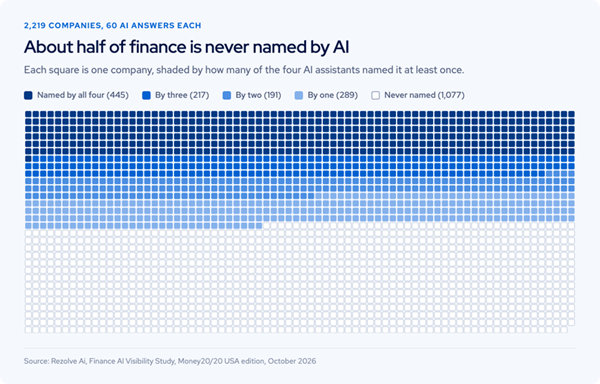
At the other end of the scale, 445 companies were named by all four assistants. These are the companies AI has firmly linked to their market’s questions. Everyone else sits somewhere in between, popping up now and then, often with just one assistant.
That in-between group is worth a closer look. On half of the questions where a company is named, only one of the four assistants names it. So, if you check your own visibility by asking one assistant one question, you could come away with the wrong picture, good or bad. The real pattern only shows up across lots of questions and several assistants.
2. It’s about size, not sector
You might expect some corners of finance to be naturally better at this. Payments people are tech people, after all, and crypto companies practically live online.
The data tells a different story. What matters most is how big and well-known a company is.
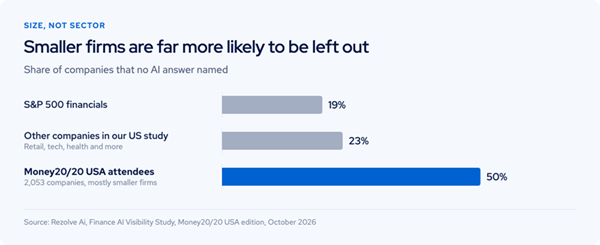
One in five S&P 500 financials is never named. That’s close to the 23% we see for the other companies in our wider US study, across retail, tech, health and more. But among Money20/20 attendees, most of them smaller firms, it’s one in two.
Now split the same numbers by type of business:
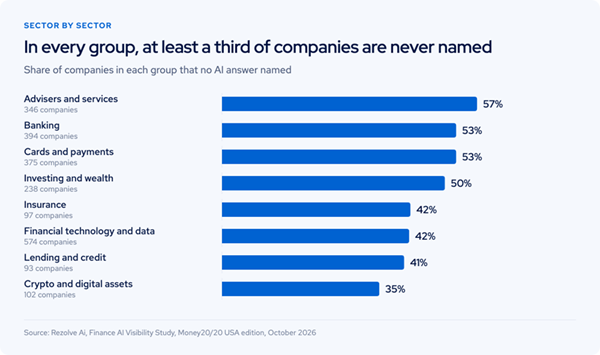
Every group has the problem. Even in the best one, crypto and digital assets, a third of companies are never named. In advisers and services, it’s well over half. Sector moves the number a little. Size moves it a lot.
For leaders of growing firms, this is the uncomfortable bit. You can have a better product, better rates and happier customers than a household name, and still be missing from the answer. AI tends to repeat what the wider web already says loudly, and the wider web talks most about the biggest brands.
3. The shortlist gets made early
Not every question is equal. We sorted all the questions by what the person was trying to do, from “what’s out there?” all the way to “I’m ready to sign up”.
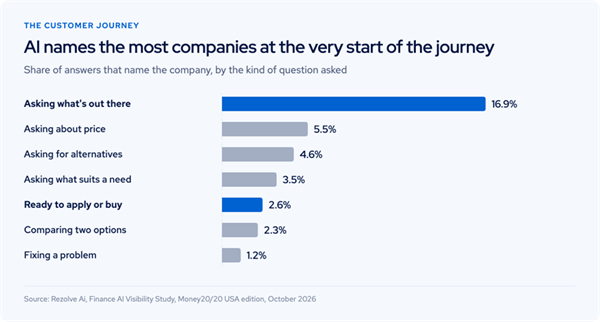
When people ask what’s out there, AI names a company in 16.9% of answers. When they’re ready to apply or buy, it drops to 2.6%.
Think about what that means for the customer journey. AI is most generous with names right at the start, while someone is still working out their options. By the time they’re ready to sign up, they usually have a shortlist, and it was very likely shaped by those early answers. If you’re missing from the “what’s out there” moment, it’s hard to get back in later.
4. AI mostly reads third-party websites
Every AI answer lists the pages it drew on, so we could see exactly where the information came from. A company’s own website turned out to be just 1.4% of all the sources AI used. Even in answers that do name the company, its own site is used less than half the time.
So, who’s doing the talking? In finance, comparison and personal finance sites play a much bigger part than anywhere else.
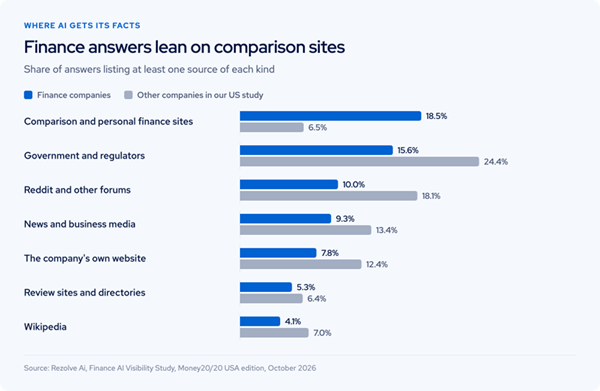
Comparison sites are a source in 18.5% of finance answers. For the other companies in our US study, it’s 6.5%, so finance leans on them almost three times as much. Bankrate is the site AI cites most, followed by NerdWallet. In banking, half of all answers list at least one comparison or personal finance site.
The takeaway is simple. In AI answers, your reputation is mostly built on other people’s websites: reviews, rankings, comparison tables, news coverage and regulators’ pages. If those sources don’t mention you, or describe you badly, AI will follow their lead.
5. The technical basics still matter
We also ran a set of technical checks on every company’s website. Can AI tools find the pages? Can they read them easily? Does the site tell AI crawlers (the automated programs that read websites for AI tools) what they’re allowed to do?
The websites that pass the fewest checks are the ones AI leaves out most. Of the least prepared websites, 69% are never used as a source by AI. For everyone else, it’s 46%.
And only about one in nine finance websites sets clear rules for AI crawlers in its robots.txt, the small file that tells automated visitors what they can and can’t read.
One of the most common mistakes is content that only shows up once someone interacts with the page: rates that load inside a calculator, answers hidden behind tabs or “read more” buttons, or whole pages built by JavaScript after they open. A person sees all of it. Many AI crawlers don’t. They read the page as it first arrives, without running scripts or clicking anything, so whatever loads later may as well not be there.
Getting the technical setup right won’t make AI recommend you on its own. Think of it as the groundwork. Content written for the questions people actually ask AI builds on top of it, and that’s what gets a company named.
Five questions customers ask AI about money
Alongside the main study, we ran a set of smaller experiments, each built around a question real customers ask. These were asked separately, they named a bank or a purchase on purpose, and they don’t count towards any company’s score. But they say a lot about how AI behaves when money is on the line.
Loyalty: “I bank with you. Who does AI suggest?”
We asked questions like “I bank with Chase. I want to open a high-yield savings account. What do you recommend?” for 24 banks and eight products.
Two in three answers named another provider. Three in ten went further and put another provider first, ahead of the customer’s own bank.
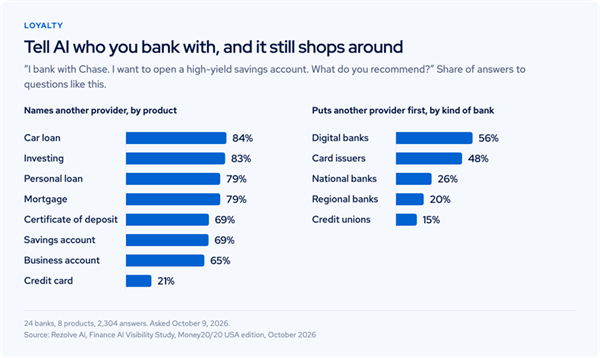
It depends a lot on the product. Ask about a car loan and AI shops around in more than four out of five answers. Ask about a credit card and it rarely does. The kind of bank matters too. Customers of digital banks lose the first recommendation most often, and credit union members least.
When AI sends someone elsewhere, the reason it gives is usually “compare before you choose” or “there’s a better rate elsewhere”. For banks, the message is clear: AI doesn’t assume loyalty. It has to be earned in the answer, product by product.
Checkout: “How should I pay for this?”
We asked how to pay for 20 everyday purchases, from a $90 online order to a $6,000 ring. For example: “I’m about to buy a laptop for about $1,200. What’s the best way to pay for it?”
The credit card won all 20. It was the top pick in about four out of five answers.
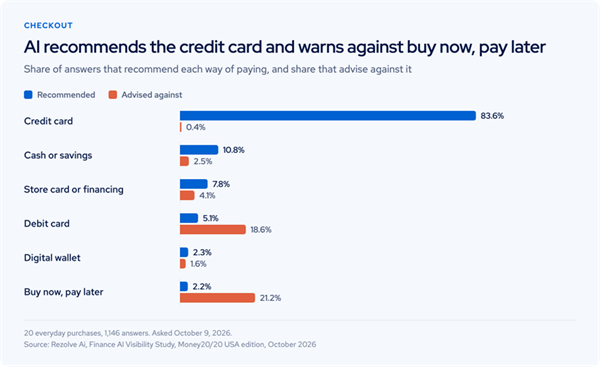
Buy now, pay later is the opposite story. AI warns against it in about one in five answers, and recommends it in just 2%.
Even the wording of the question makes a difference. Ask openly and about half of the answers pick a card. List four options, and nearly all of them do.
And the reason AI gives for its pick? Rewards or cash back, in 86% of answers. Here’s the twist for issuers and banks: in the main study’s everyday questions about finance companies, rewards come up as a reason to choose in only 2.1% of answers. So,rewards decide the answer at the till but barely feature when people are choosing who to bank with.
Wealth: “Say you have $10 million”
We asked the same wealth questions with and without a statement of how much the customer has, such as “I have about $10 million in investable assets. Which firm should I use to manage my investments?”
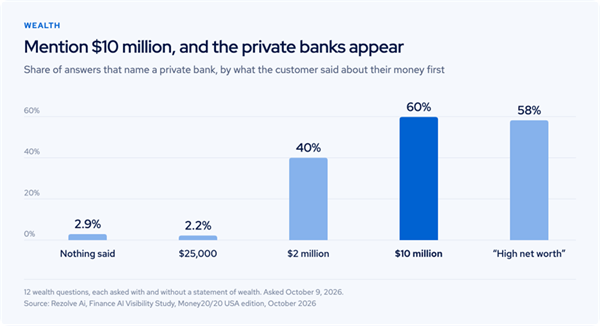
When nothing is said about money, private banks appear in 3% of answers. Mention $10 million, and they appear in 60%. J.P. Morgan Private Bank goes from almost never named to the most named firm.
Where you pay tax changes things too. Say you’re tax resident in the UAE, and Emirates NBD leads the answers.
The lesson is that AI personalizes. One sentence about the customer can reshape the whole shortlist. If your firm serves a particular kind of customer, the content AI reads needs to say so, clearly and often.
Mortgages: “What mortgage rate should I expect?”
Mortgage answers lean heavily on comparison sites. Bankrate alone is cited in a third of them. Rocket Mortgage is the lender AI names most. And if you ask about buying a first home, AI points to government programs such as VA, FHA and USDA loans rather than to any bank.
We also checked the rates. We compared every 30-year rate an answer gave as “today’s rate” with Freddie Mac’s weekly survey for that week.
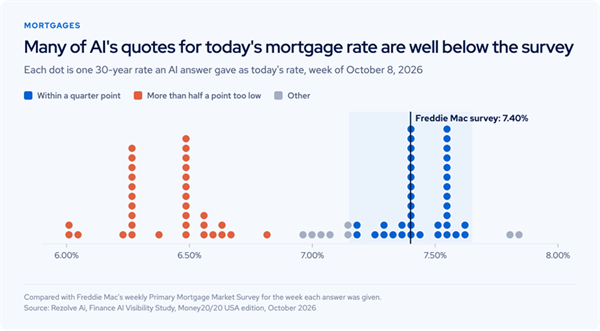
About half of those quotes were within a quarter point of the survey. But more than a third were over half a point too low. Rates had risen in the weeks before, so answers that leaned on older articles quoted rates that no longer existed. Picture a customer walking into a branch with that number in their head.
AI agents: “Can an AI agent do business with you?”
The next step is already arriving: AI agents that don’t just recommend but act on the customer’s behalf. Paying is the obvious first job. In finance, agents could soon open accounts, move money or place trades too. For any of it to work, a website must tell an agent how to transact. We checked for the simplest version: a published way for an agent to check out.
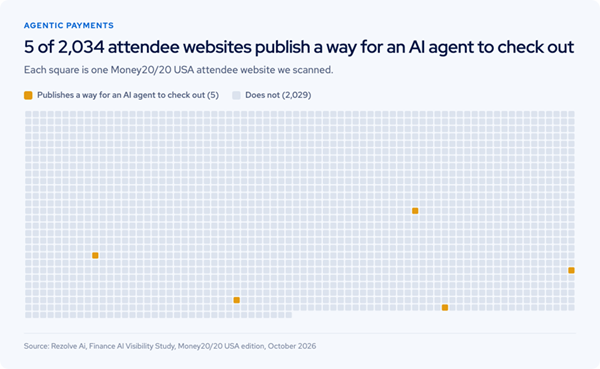
We scanned 2,034 attendee websites. Five publish a way for an AI agent to check out. None of the S&P 500 financials do. For an industry built on payments, that’s a striking gap, and an opportunity for whoever moves first.
Who AI names most
These are the Money20/20 attendees AI brought up most often, out of 60 answers each.
| # | Company | Group | Named in |
| 1 | SWIFT | Cards and payments | 47 of 60 |
| 2 | TransUnion | Lending and credit | 46 of 60 |
| 3 | Experian | Lending and credit | 42 of 60 |
| 4 | Navy Federal Credit Union | Banking | 41 of 60 |
| 5 | Coinstar | Cards and payments | 41 of 60 |
| 6 | Zelle | Cards and payments | 41 of 60 |
| 7 | TradingView | Financial technology and data | 38 of 60 |
| 8 | Bloomberg L.P. | Financial technology and data | 38 of 60 |
| 9 | PayPal | Cards and payments | 37 of 60 |
| 10 | Equifax | Lending and credit | 33 of 60 |
Remember that each company was asked about in its own market. So, these are the companies AI brings up most when people ask about theirs.
Here’s an interesting wrinkle: the most named company isn’t at the top of our overall ranking. Our overall score combines five measures. It’s led by how often AI names a company, and it also counts how often AI uses the company’s own website as a source and how positively it describes it. On that score, PTO Exchange comes first. AI names it in about a quarter of answers about its niche, and its own website is the main source. SWIFT is named in 78% of its answers, but AI mostly cites other websites about it and describes it neutrally, so it ranks second.
That’s genuinely good news for smaller firms. You don’t have to be famous to own your market’s answers. You must be the clearest, best-sourced answer to the questions your customers ask.
What we’d do on Monday morning
If you lead a finance business, here’s where we’d start.
- Ask the questions your customers ask. Not your brand name, their problems: “best business account for a startup” or “cheapest way to send money abroad”. Try several AI assistants and ask multiple times over several days. One answer from one assistant can mislead.
- Win the start of the journey. AI hands out the most names when people ask what’s out there. Make sure clear, useful content answers those early questions, on your own site and beyond it.
- Earn your place on the sites AI trusts. In finance, that means comparison and personal finance sites, review sites, news and regulators. Check what they say about you and keep it current.
- Get the groundwork right. Let AI crawlers in and publish clean pages that are easy to read. Put the things that matter, like rates, fees and product details, in the page itself rather than behind clicks or JavaScript. And keep them up to date, because old numbers travel further than you’d think.
- Get ready for agents. AI agents won’t stop at paying for things. Soon they could open accounts, move money or place trades for a customer. Today, almost no finance website even publishes a way for an agent to check out. The firms that make it easy for agents to transact early will be the natural choice when that happens.
Look up your own company
Every one of the 2,219 companies has its own page in the study, with all 15 questions and every assistant’s answer to read. It’s free to explore at aeo-audit.rezolve.com/us/finance.
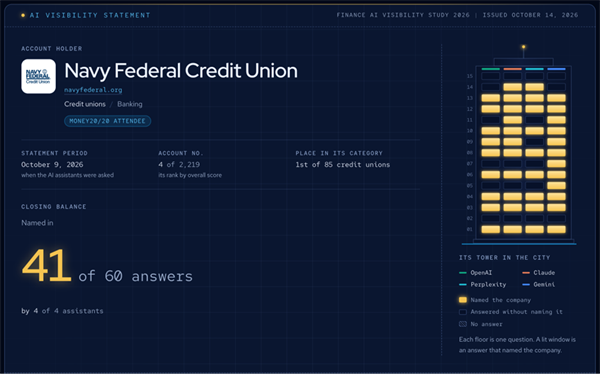
Every company gets a page like this one. Navy Federal Credit Union was named in 41 of its 60 answers, by all four assistants.
We’d love to hear what you find. And if you’d like to talk through what it means for your business, the team at Rezolve Ai is always happy to help.
About the study
- Companies: 2,219 finance companies, 2,053 of them on the Money20/20 USA 2026 attending companies list (as of October 1, 2026). Each one is filed under one of eight groups and 40 categories.
- Questions: 15 per company about its own market (never naming a company in the prompt) put to OpenAI, Claude, Perplexity and Gemini, each with web search enabled. Answers were collected in September and October 2026.
- Experiments: the loyalty, checkout and wealth questions were asked separately, named a bank or a purchase, and count towards no score. A second AI model read a sample of each again and agreed on the headline figure in 75% to 97% of answers.
- Read with care: 1,461 companies were named fewer than three times, so their individual scores are weak evidence.