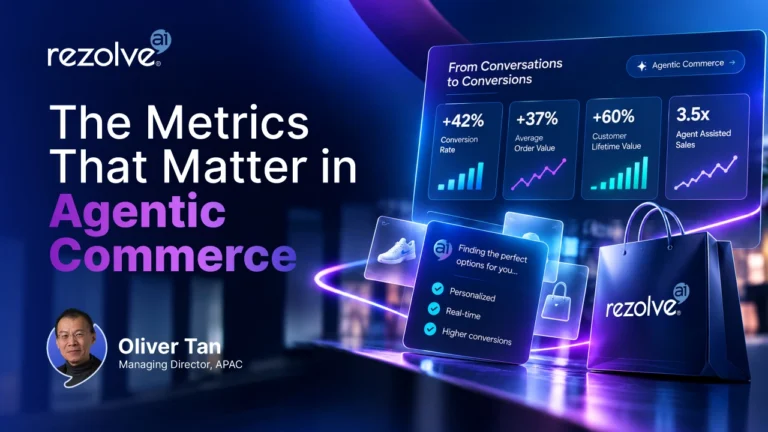
How customers choose, converse, convert and choose to come back with agentic commerce.
The most important customer right now isn’t a person.
It’s an AI agent acting on a person’s behalf. It doesn’t browse, scroll, or abandon a basket. It asks a question, gets a shortlist of 3-4 recommendations, and moves on. Brands that didn’t make the list have already lost the sale because they were never on the radar, and according to our AI Visibility Study, around 1 in 4 brands in the US never make the cut.
For an industry that has spent two decades optimizing the checkout, analysts agree being invisible is already a major threat:
- AI-referred shoppers now convert 60% more often than other traffic (Adobe)
- Agents could account for 15-25% of US e-commerce sales by 2030 (Bain)
- By 2030, agent-orchestrated commerce is estimated to reach $3-5 trillion globally (McKinsey)
The sales funnel has collapsed from scrolling to delegating
The average ecommerce site converts about 2.9% of its visitors because merchants can access the data needed to properly guide a customer to payment. Even though merchants already know what the customer bought, what they returned and why, and loyalty balances held, the data lives in separate systems built for reports rather than personalization and ROI.
The data exists but it’s stranded in the wrong place at the moment it matters.
Four steps, one loop
What replaces the funnel is a loop:
- Discovery: product data is rewritten so an agent can read it. This is answer engine optimization, and it decides who makes the shortlist.
- Engagement: an AI concierge on the merchant’s own page knows the shopper’s history and confirms stock and delivery.
- Payment: the sale closes on the same platform, with no hand-off to a separate processor.
- Return: a merchant-funded offer, chosen from card spending and paid for only when she buys, brings her back. Every transaction feeds insight into how demand is shifting.
- Insights: Here’s the part that compounds. Every conversation and transaction captures 1st party data to become more visible in discovery. Each turn of the loop makes the next one more personalized and likely to convert.
Why this matters to payments
With agentic commerce, payment portals are a dying breed, because purchase will happen within the conversation, maintaining the value of the data from being “recommended” through an LLM, to payment, on one platform.
Payment is no longer a hand-off at the end of the journey but a layer inside it.
Merchants can’t upend legacy payment systems, nor do they need to because payment is simply a layer within a platform that lives on top of they already run. No rip and replace needed.
The question I have at Money20/20
How have you pivoted your strategy to reach customers when they’re an agent?
When an agent shops on your customer’s behalf, are you on the shortlist?
And when they choose you, is your strategy leveraging the data you’ve earned to drive more sales?
$3-5 trillion dollars of purchases will run on someone’s infrastructure. I’d love to compare notes at Money20/20 on what it takes to be ready.